Searching for Exotrojans in Pulsar Systems
Jackson D. Taylor et al. · The Astrophysical Journal 1000, 82, 16 pp. (2026)
doi:10.3847/1538-4357/ae4317
Searching for Exotrojans in Pulsar Systems
The Astrophysical Journal1000, 82, 16 pp.(2026)
In plain language
We looked for features of our own solar system, Trojans, around eight pulsars. We did not find any, but placed the first limits on how heavy Trojans around pulsars can be.
~1 Earth mass
is the heaviest Trojan that could be hiding around these eight pulsars without us seeing it
What we did
Jupiter shares its orbit with thousands of asteroids. They gather at two points, one 60 degrees ahead of the planet and one 60 degrees behind. There, the pull of the Sun and of Jupiter combine into just the force needed to carry a body around at Jupiter's own pace. These bodies are known as Trojans, because the first Trojan was named after a hero in the Trojan War. Despite their multitude in our own solar system, astronomers have yet to find them around another star. We searched around pulsars that have binary companions to see if they host any Trojans. Pulses from a pulsar arrive on a schedule that can be predicted very accurately, so a Trojan in the system would tug the pulsar around and leave a unique marker in those arrival times. We searched the arrival times of eight pulsars in the NANOGrav 15 year dataset.
What we found
No Trojans. Across all eight pulsars nothing in the times of arrival indicates Trojans. However, we found that a Trojan in those systems could be lighter than the Earth and still not detectable. Two systems, PSR J0023+0923 and PSR J1705−1903, show a weak signal of the sort a Trojan of two to four Jupiter masses would make, but we think that these are false positives. For the PSR J1641+8049 system, we looked for inconsistencies between an optical light curve and the radio times of arrival and ruled out Trojans heavier than about eight Jupiters.
Why it matters
Trojans are common in our own solar system, so it is reasonable to ask whether they exist elsewhere. Nobody had done a serious study of Trojans around pulsars before. These are the first observational limits on pulsar-bound Trojans. If Trojans are absent, then their absence must be explained. We don't rigorously investigate how Trojans could form around pulsars, leaving that to more theoretical work.
Words used here
- Trojan
- A small body that shares a larger body's orbit, sitting near one of the two stable points 60 degrees ahead of or behind it. Jupiter has at least thousands of them.
- Exotrojan
- A Trojan in another star system. None have been confirmed, although there are candidates.
- Libration
- The slow rocking of a Trojan back and forth around its stable point rather than sitting still. That rocking is what makes it detectable.
- Times of arrival
- The moments a pulsar's pulses reach the telescope. Comparing them with a model is how pulsar astronomers make inferences.
- NANOGrav 15 year dataset
- Fifteen years of precisely timed observations of dozens of millisecond pulsars, collected by the NANOGrav collaboration.
A closer look
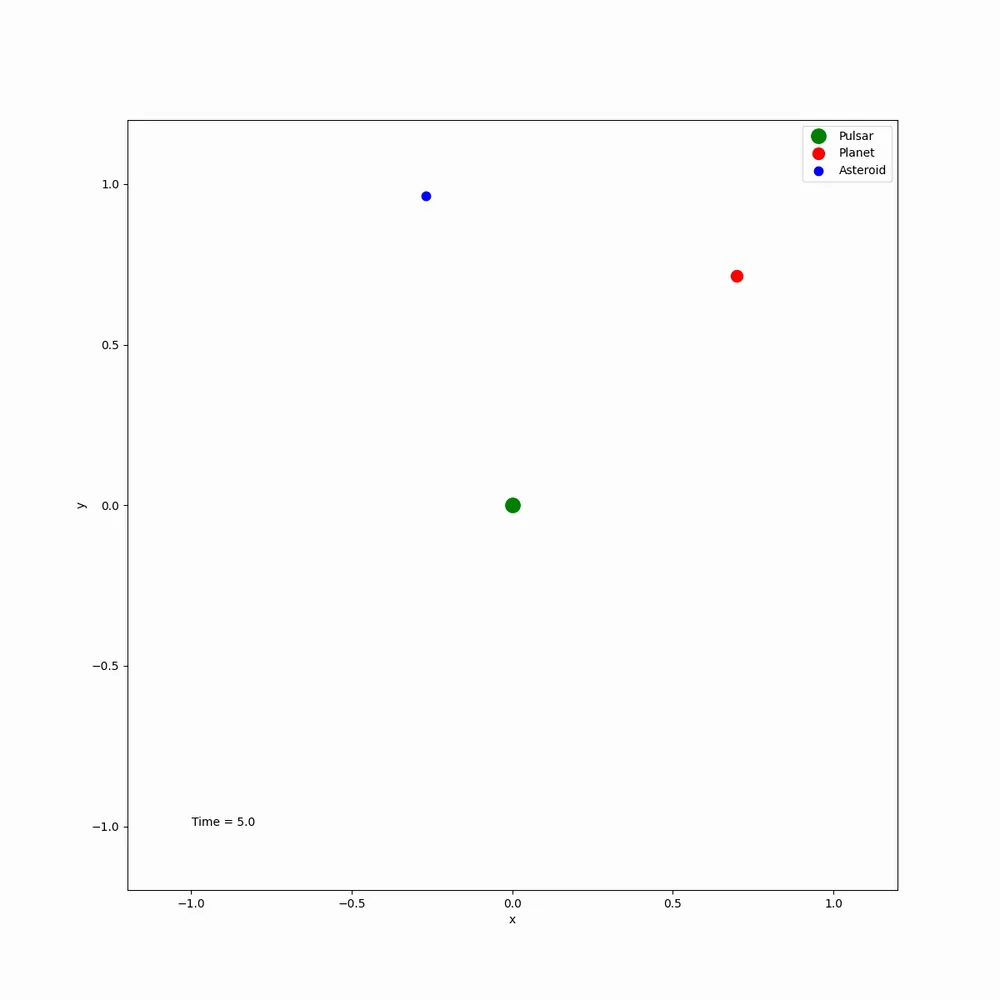
Two bodies in orbit make two places, sixty degrees ahead of and behind the smaller one, where a third object can stay put. Thousands of asteroids sit in those places in the Sun–Jupiter system. An object parked there swings slowly around the point, and its pull shifts the pulsar by a small amount. That shift is the only part of this a telescope can measure.
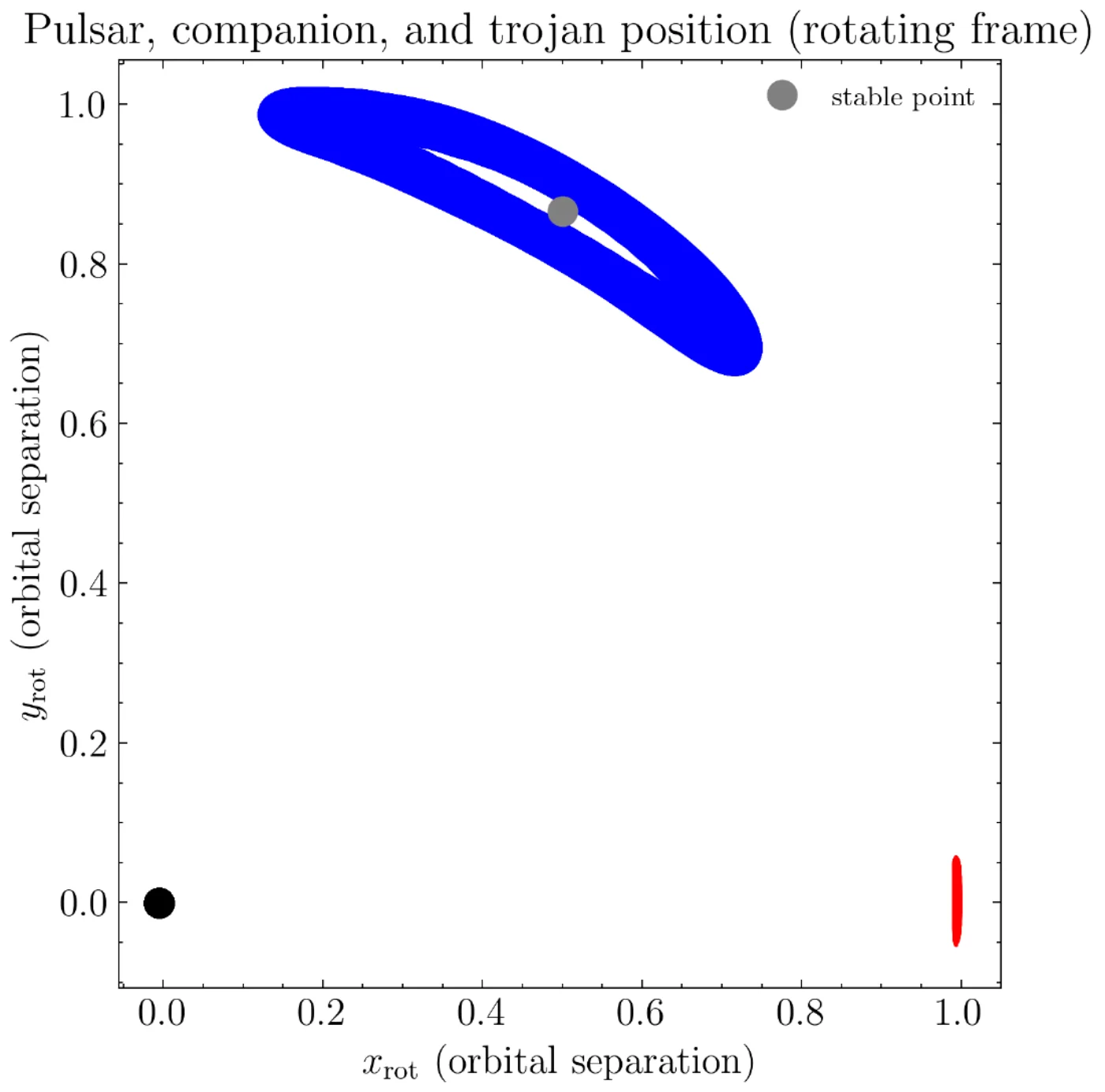
We did not find any. This is what one would have looked like.
- the pulsar, about 1.4 solar masses
- the companion, about 0.01 solar masses
- the asteroid
- the loop it traces
Drawn in a frame that turns once per orbit, so the companion stays put and only the asteroid moves. The loop is calculated for a Trojan started twenty degrees off L4 and followed for one complete swing. The swing is wide and slow, taking about four orbits of the binary.
Your system is set to reduce motion, so nothing here moves by itself. Step forward advances the simulation a quarter of an orbit each time you press it. Play still works if you would rather watch it run.
What the telescope measures: the pulsar's own small shift, along the line of sight
Faint vertical lines mark one orbit of the binary. The repeating part is the orbit itself. The slow swell on top of it is the Trojan.
Started twenty degrees off the point. It swings between about forty-two and eighty-two degrees, still taking about four orbits per swing, and the loop it traces is the tadpole shape. The slow rise and fall in the pulsar trace is much larger.
The orbital motion here is really calculated. The sizes and the signal strength are not to scale.
Really calculated. The path comes from the circular restricted three-body problem in the rotating frame, integrated with a fourth-order Runge–Kutta step that is fixed and does not depend on how fast your screen refreshes. The mass ratio is the one the paper works with: a companion of about 0.01 solar masses against a 1.4 solar-mass pulsar. That is far below the ratio at which these points stop being stable, so the slow swing around L4 holds up for as long as you care to watch.
Not to scale. Lengths are set so the separation is one and the orbit takes one period. The bodies are drawn enormously larger than they are. The trace at the bottom is proportional to the pulsar's displacement with an arbitrary tilt and an arbitrary size, so the shape is right and the amplitude means nothing; the real search was sensitive to about one Earth mass. There is no relativity in any of it.
Describe this figure in words
The diagram is drawn in a frame that turns once per orbit, so the two heavy bodies stay where they are and only the asteroid moves. The pulsar is the small filled circle on the left. The companion, about a hundredth of a solar mass, is the larger circle on the right. The dashed circle is the companion's orbit.
Sixty degrees around from the companion, measured at the pulsar, is the point marked L4. The dashed triangle joining the pulsar, the companion and L4 has three equal sides, which is the condition that defines the point. L5 is the mirror image of it below the line. Both are places where the pull of the two bodies and the turning of the frame cancel out.
An object placed exactly at L4 stays there. Place it a little off and it swings around the point and comes back. The closed loop drawn around L4 is one of those swings, for an object started twenty degrees away. The shape is why these are called tadpole orbits. Going round the loop once takes about four orbits of the binary, so the motion is slow compared with the orbit it sits in.
Start it far enough from the point and it is not held at all. It drifts around the whole orbit, its distance from the pulsar changing as it goes, and never settles into a loop around sixty degrees.
The strip below the running version is the part that matters for the search. The asteroid pulls on the pulsar, so the pulsar is not quite where it would be without it, and that shows up as a change in when its pulses arrive. The trace repeats once per orbit, and a signal at exactly the orbital period is difficult to separate from the orbit itself, since fitting the binary absorbs it. The part that would give a Trojan away is the slow swell riding on top, at the libration period. That is what we looked for.
Eight pulsars were searched and no Trojan held up in any of them, which is where the mass limits in the paper come from.
Figures
Abstract
Trojan asteroids are found in the equilateral triangle Lagrange points of the Sun–Jupiter system in a great number, although they also exist less prolifically in other parts of the solar system. Despite up to planetary mass Trojans being predicted in extrasolar systems (i.e., exotrojans), they remain unconfirmed, although strong candidate evidence has emerged recently. For the first time, we extend the search for exotrojans to radio pulsars with low-mass (∼0.01 M⊙) companions using accurately measured pulse times of arrival. With techniques developed for detecting the reflex motion of a star due to a librating Trojan, we place ∼1 M⊕ upper mass constraints on potential exotrojans around eight pulsars observed in the NANOGrav 15 yr dataset. We find weak evidence consistent with ∼2–4 MJ exotrojans in the PSR J0023+0923 and PSR J1705−1903 binary systems, although the signals likely have a different, unknown source. We also place a libration-independent upper mass constraint of ∼8 MJ on exotrojans in the PSR J1641+8049 system by looking for an inconsistency between the times of superior conjunction as measured by optical light curves and those predicted by radio timing. These results offer initial observational constraints on the existence of exotrojans around pulsars, while their possible formation mechanisms remain unexplored.