Algorithmic Pulsar Timer for Binaries
Jackson Taylor et al. · The Astrophysical Journal 964, 128, 10 pp. (2024)
doi:10.3847/1538-4357/ad1ce9
Algorithmic Pulsar Timer for Binaries
The Astrophysical Journal964, 128, 10 pp.(2024)
In plain language
Timing a pulsar means counting every single rotation it makes even between telescope observations that can be months apart. We built a software that does this counting with minimal human input, allowing us to solve two newly discovered pulsars before any human could.
13 years
of Green Bank Telescope observations tied together into one unbroken count of rotations
What we did
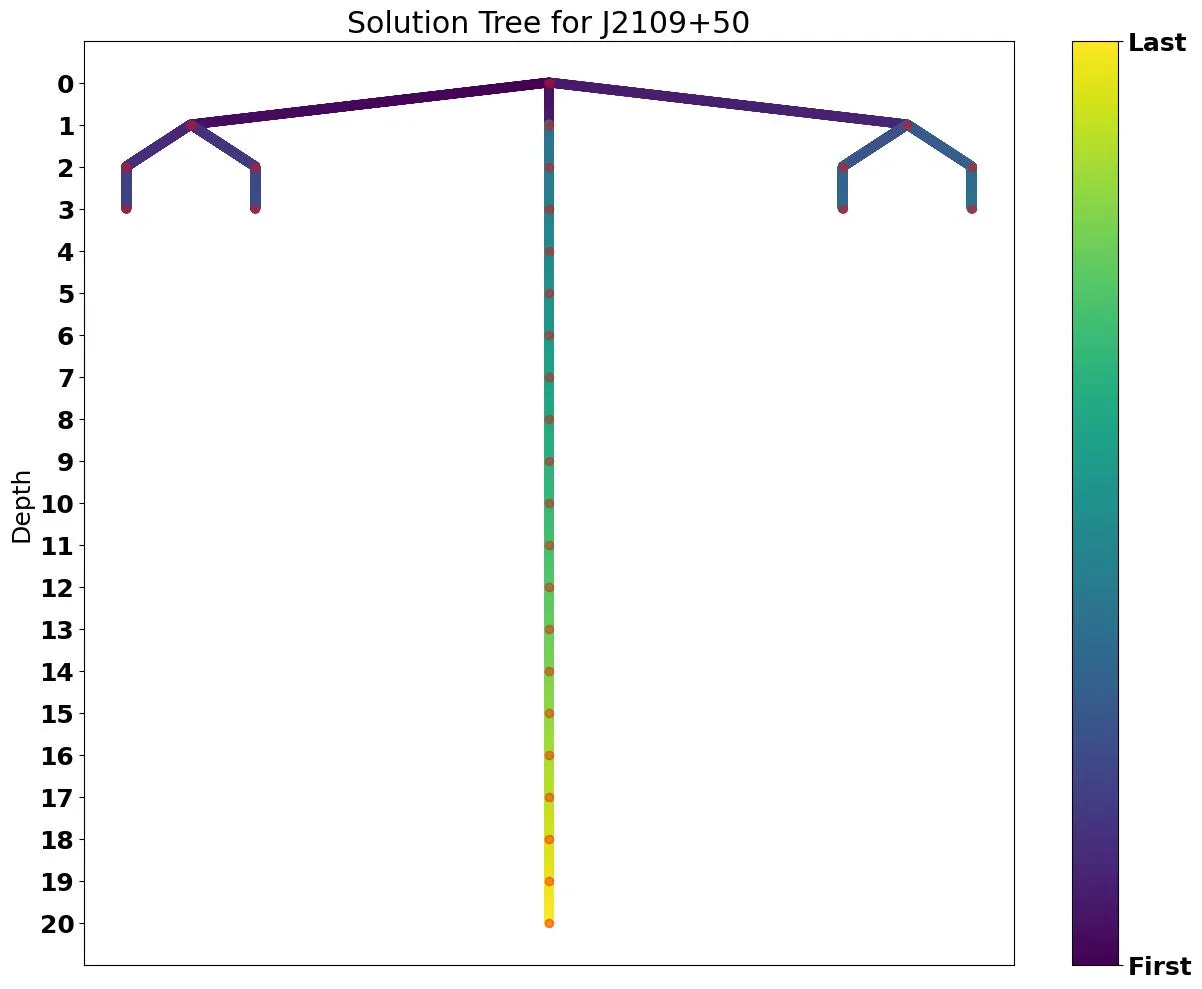
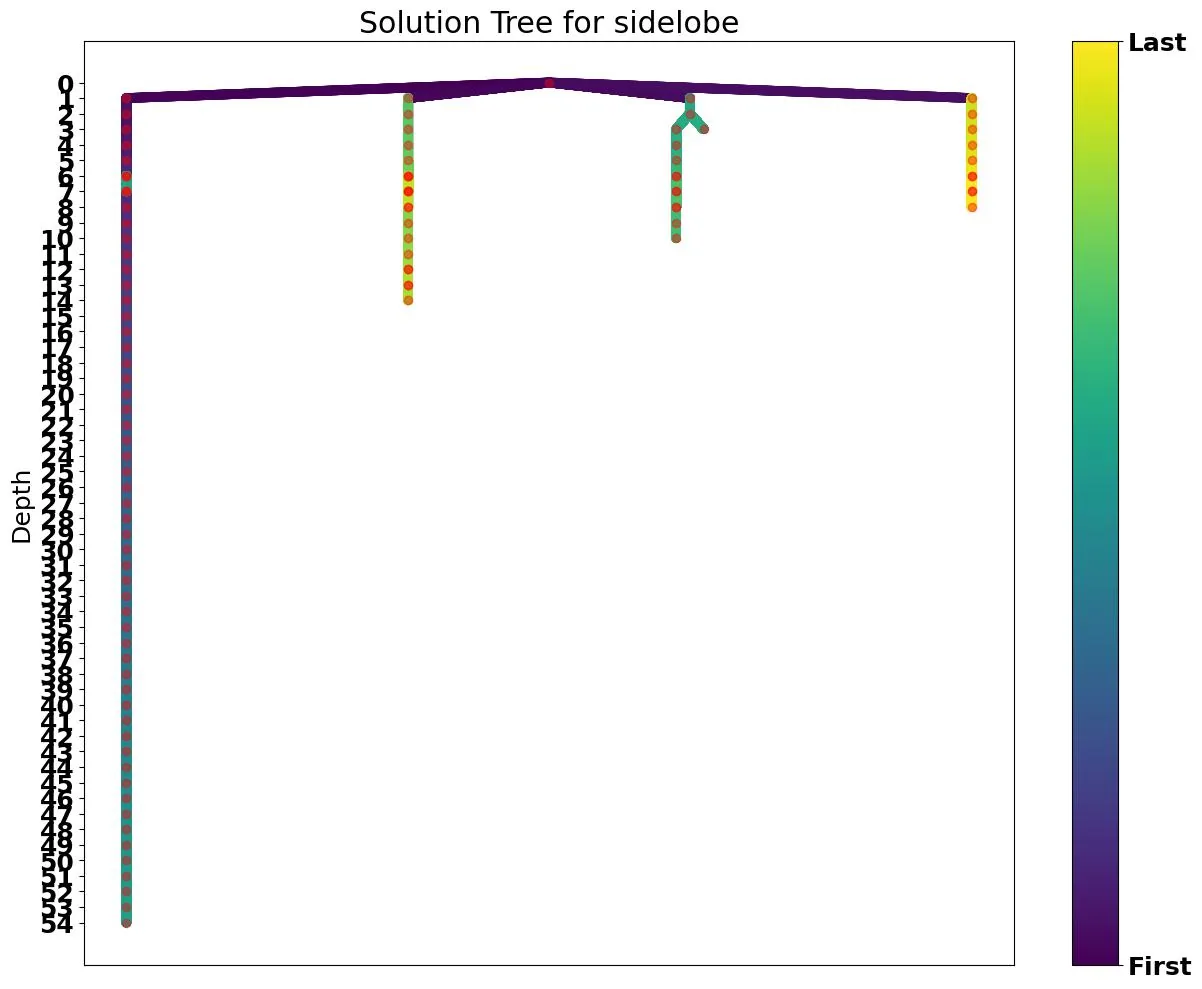
A pulsar is a collapsed star that sweeps a radio beam past Earth like a lighthouse. Accounting for every rotation between observations allows astronomers to learn the position of the star, how fast it spins, how that speed is changing, and the shape of its orbit if it has a companion. What's difficult is that our prior understanding of the pulsar is sometimes so inaccurate that this process can take hours, days, or simply be impossible to be carried out by an astronomer. A telescope might not look at a pulsar for months, and the number of rotations missed in between has to be exactly right. We wrote an algorithm that explores possible missed rotation counts in a tree-like manner, checks each one with standard statistical tests, and discards branches that fail.
What we found
The method works. We used it to establish the timing solutions for two binary pulsars that had just been discovered in Terzan 5. Terzan 5 is a globular cluster (a big ball of stars) near the center of the Milky Way. These pulsars are called PSR J1748−2446aq and PSR J1748−2446at. For both, the algorithm pieced together about 70 Green Bank Telescope observations spread over 13 years.
Why it matters
A newly discovered pulsar is not much use to anyone until someone has worked out its timing solution, and doing that by hand takes both practice and a tightly controlled observing schedule. An algorithm that handles the counting lowers both of those costs, and it works on binary pulsars, which are trickier than pulsars without orbiting companions.
Words used here
- Pulsar
- A collapsed, fast-spinning star that sends out a beam of radio waves. We see a pulse each time the beam sweeps past Earth.
- Timing solution
- A model that accounts for every rotation a pulsar has made across years of observing. It gives the spin rate, the position on the sky, and characteristics of its orbit if there are any.
- Phase connection
- Knowing the exact number of rotations between two observations, with no ambiguity. It is what makes a timing solution precise.
- Binary pulsar
- A pulsar in orbit with another star. The orbital motion shifts the arrival times of the pulses, which adds unknowns to the timing solution.
- Globular cluster
- A tightly packed, ancient group of hundreds of thousands of stars. Terzan 5, where these two pulsars live, is a globular cluster.
A closer look
A millisecond pulsar turns a few hundred times a second. Timing one means accounting for every rotation, including the ones that happened while the telescope was pointed somewhere else. The count is a whole number, and a wrong count leaves a smooth pattern in the data.
Vertical scale: ±50 microseconds (arbitrary units), the same for every count. The grey band is one uncertainty wide.
Negative means you counted too many. Arrow keys move one turn at a time.
Fit score (reduced χ²): 158.08
One is what you get when the leftovers are the size of the measurement uncertainty and nothing else. Anything much larger means there is still a shape in the data that the fit cannot account for.
Try three or more counts and a curve appears through the scores.
Missed turns: minus three. Fit score 158. The points bend away from the line in a smooth curve.
An illustration of the idea. Real data are fit with a full timing model.
Really true of the method. The count can only be a whole number. A wrong count leaves a smooth pattern in the residuals. The fit score follows a parabola near its lowest point, and the curve in the small panel is fitted to the scores you have tried. A longer gap leaves more counts that fit almost as well as each other.
Made up for the picture. The arrival times are invented. The fit is a three-term polynomial, not a timing model, and there is no binary orbit in it. The units are arbitrary. The order the search tries candidates shows how a tree gets pruned. The paper also prunes on reduced χ², but before cutting a branch it uses an F-test to decide whether adding a fit parameter rescues it. That step is not shown here.
Describe this figure in words
The upper strip is a calendar. Five short observing sessions, five arrival times each, are marked as vertical ticks. The first three sessions sit close together in the first three months. Then nothing for about326 days. The last two sessions sit at the far right. The shaded block is the long gap.
The lower panel plots, for each arrival time, how far it landed from where the fit said it would. The horizontal line is zero. The grey band is one measurement uncertainty either side of it. The smooth line through the points is what the chosen count predicts before the noise is added.
At the correct count the points sit inside or near the grey band with no order to them. The smooth line is flat on zero, and the fit score is about one.
At any other count, the points leave the band and lie along a curve that sags on one side and rises on the other. That curve is the signature of a count that is off by a whole number, and it is easy to see, which is what makes the right answer findable.
The small panel on the right keeps a record. Every whole number from-6 to 6 is a dot on the axis. When you try one, its dot rises to the fit score it earned. After three tries the dots turn out to lie on a parabola, and once you know the parabola you can read off where its lowest point is without trying every value. That is the shortcut the paper uses.
The button walks a search outward from wherever you left the slider. It takes a step, keeps going in that direction while the score falls, and stops that direction as soon as the score rises. Both directions close in on the same answer. Here it is 2 turns, with a fit score near one.
The longer the gap, the more counts give a score close to the best one, and the harder the problem gets. A gap of a few days can usually be bridged by eye. A gap of a year, with a binary orbit on top of it, is where an automated search helps the most.
Figures
Abstract
Pulsar timing is a powerful tool that, by accounting for every rotation of a pulsar, precisely measures the spin frequency, spin frequency derivatives, astrometric position, binary parameters when applicable, properties of the interstellar medium, and potentially general relativistic effects. Typically, this process demands fairly stringent scheduling requirements for monitoring observations as well as deep domain knowledge to “phase connect” the timing data. We present an algorithm that automates the pulsar-timing process for binary pulsars, whose timing solutions have an additional level of complexity, although the algorithm works for isolated pulsars as well. Using the statistical F-test and the quadratic dependence of the reduced χ2 near a minimum, the global rotation count of a pulsar can be determined efficiently and systematically. We have used our algorithm to establish timing solutions for two newly discovered binary pulsars, PSRs J1748−2446aq and J1748−2446at, in the globular cluster Terzan 5, using ∼70 Green Bank Telescope observations from the last 13 yr.